 PLASTIC INDUSTRY EXPORT RESEARCH
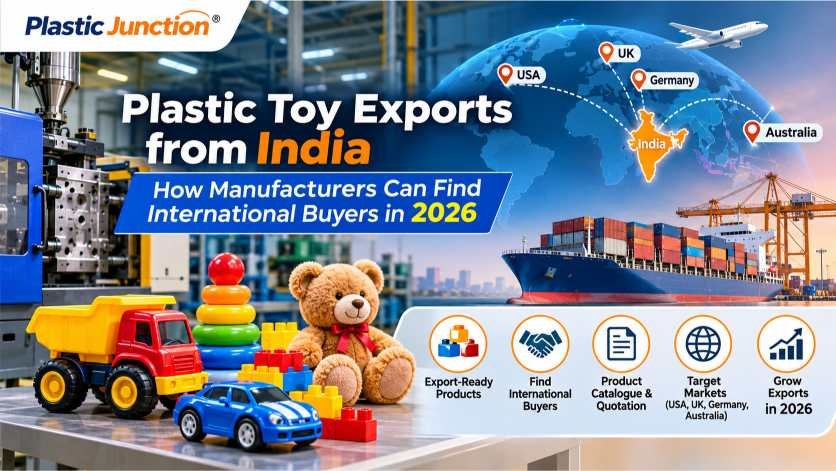
Plastic Toy Exports from India: How Manufacturers Can Find International Buyers in 2026
Market analytics, export destinations, buyer acquisition and manufacturing strategy
For Plastic Junction | Market analytics, export destinations, buyer acquisition and manufacturing strategy
Research date: 27 October 2026
Geographic focus: Indian manufacturers targeting international markets
Primary audience: Plastic toy manufacturers, injection moulders, OEM suppliers, private-label manufacturers and exporters
1. Executive summary
The core claim is verified: India's toy exports have grown substantially, and the United States is a particularly important destination for Indian toy products. However, one important distinction is necessary: official toy-export statistics include multiple types of toys and recreational products, not exclusively plastic toys.
The latest government figures available in the research show:
| Indicator | Reported figure | What it tells us |
|---|---|---|
| India's total toy exports, FY 2025–26 | US$384.7 million | Export activity across the covered toy categories |
| India's total toy exports, FY 2018–19 | US$203.5 million | Historical comparison |
| Growth from FY 2018–19 to FY 2025–26 | 89.1% | Significant growth over seven years |
| India's toy imports, FY 2025–26 | US$232.3 million | Imports declined relative to FY 2018–19 |
| Toy imports, FY 2018–19 | US$371.7 million | Historical comparison |
| Import decline over the period | 37.5% | Lower import value than the earlier period |
These figures come from the Indian Ministry of Commerce and Industry, reported by the Press Information Bureau (PIB) on 28 July 2026. The figures cover HS codes 9503, 9504 and 9505—not just plastic toys. Source: PIB
Commercial implication: Plastic toy manufacturers may have an opportunity to expand internationally, but success depends on identifying the correct product categories, choosing suitable markets, meeting safety requirements and reaching qualified buyers. Growth in total toy exports does not automatically mean every plastic toy category is growing at the same rate.
2. The most important analytics: plastic toy-related exports
To understand the opportunity for plastic toy manufacturers, we need to separate the overall toy industry from the narrower category of toys classified under HS 9503.
The World Bank's World Integrated Trade Solution (WITS), using UN Comtrade data, provides country-level exports for HS 950390, described as “Toys nes” (toys not elsewhere specified).
India's HS 950390 exports by destination — 2025
| Export destination | Export value (US$ million) | Export quantity (tonnes) | Share of India's HS 950390 exports |
|---|---|---|---|
| United States | $99.57M | 4,748.6 | 51.9% |
| United Kingdom | $17.00M | 810.6 | 8.9% |
| Poland | $11.17M | 532.7 | 5.8% |
| Netherlands | $7.92M | 377.6 | 4.1% |
| Germany | $6.39M | 304.6 | 3.3% |
| Australia | $4.44M | 211.7 | 2.3% |
| United Arab Emirates | $3.47M | 165.5 | 1.8% |
| Other destinations | $42.01M | 2,003.4 | 21.9% |
| Total | $191.96M | 9,154.7 | 100% |
Source: WITS/UN Comtrade, India's 2025 exports under HS 950390. Shares and tonnes have been calculated from the reported export values and quantities. View WITS data
Important limitation: HS 950390 is not a pure plastic-toy category. It covers a broader range of toys, so these figures are a useful proxy for the market opportunity, not a verified total for plastic toys alone.
What the numbers tell us
1. The United States is the clear first market to investigate.
It accounted for approximately 52% of India's exports in this category in 2025. Its export value was nearly six times India's exports to the UK.
2. Europe offers several potential markets.
The UK, Poland, the Netherlands and Germany together accounted for approximately 22.2% of India's exports in this category.
3. Australia is worth evaluating, but it is a smaller destination for this category.
India exported approximately $4.44 million of HS 950390 products to Australia in 2025.
4. Market concentration creates both opportunity and risk.
The United States is a substantial existing market for Indian exporters, but excessive reliance on one destination can expose manufacturers to tariff changes, regulatory changes, and shifts in buyer demand. Diversification may be sensible.
These are observations about existing trade flows—not proof that any specific product will sell profitably in these countries.
3. Is India's toy export boom real?
Yes. Official Indian government data supports the broader claim that toy exports have increased substantially.
The Ministry of Commerce and Industry reported the following figures in July 2026:
| Financial year | Toy exports | Toy imports | Trade balance |
|---|---|---|---|
| FY 2018–19 | $203.5M | $371.7M | −$168.2M |
| FY 2025–26 | $384.7M | $232.3M | +$152.4M |
| Change | +89.1% | −37.5% | $320.6M improvement |
Trade balance is calculated as exports minus imports. Figures are rounded.
Source: Ministry of Commerce and Industry — official toy export figures
The government's broader toy-export series also reports that exports under HS 9503 grew from $77.35 million in FY 2017–18 to $200.89 million in FY 2025–26, an increase of approximately 160%. This category includes electronic and non-electronic toys; it does not isolate plastic toys. Source: PIB
What this means for manufacturers
The data supports three conclusions:
- India has become a more significant exporter across the covered toy categories.
- India already has established trade relationships with major international markets.
- Manufacturers should investigate export opportunities rather than assume that international demand is inaccessible.
However, the export boom does not establish that all plastic toy manufacturers are growing or that demand for every toy type is increasing.
For a manufacturer deciding whether to invest in a new mould, the relevant questions are more specific: What is the demand for its exact product, who buys it, what price can it command, and what compliance costs apply?
4. Which plastic toy products should manufacturers consider exporting?
The following shortlist is based on manufacturing practicality and buyer suitability. It is a strategic assessment, not a verified ranking of the fastest-growing export products.
| Product category | Potential buyer | Manufacturing considerations | Initial assessment |
|---|---|---|---|
| Toy cars and vehicles | Toy brands, wholesalers, retailers | Injection-moulded parts, wheel assembly, colour consistency | Worth investigating |
| Construction and building toys | Educational toy brands, distributors | Dimensional accuracy, part fit, small-parts safety | Worth investigating |
| Educational plastic toys | Educational suppliers, school distributors | Age suitability, durability, usability | Worth investigating |
| Dolls and doll accessories | Toy brands, private-label buyers | Component quality, appearance, assembly | Product-specific |
| Electronic plastic toys | Toy brands, importers, OEM buyers | Enclosures, electronic assembly, battery safety, testing | More complex |
| Outdoor plastic toys | Retailers, distributors, specialist brands | Durability, packaging, shipping volume | Product-specific |
My recommendation
For an injection moulding company entering toy exports, investigate toy vehicles, simple construction toys, and selected educational toys first.
These product categories can be assessed for moulding feasibility, assembly requirements, repeat orders and potential differentiation.
That does not mean they are automatically the most profitable. Product economics will depend on mould investment, expected order volume, competition, packaging, freight and testing.
A crucial distinction: components versus finished toys
A plastic component manufacturer has two possible routes:
- Supply components to existing toy manufacturers. Examples include wheels, housings, body panels and moulded accessories.
- Manufacture complete toys for brands or distributors. This involves greater responsibility for product design, assembly, packaging, quality assurance and applicable safety requirements.
The first route may suit an established injection moulder with strong process control. The second may offer more product ownership but requires a broader operational capability.
5. Which international markets should Plastic Junction recommend?
The data supports prioritising markets for investigation, but manufacturers should also assess tariffs, regulations, landed cost and buyer requirements.
Market 1: United States
Why investigate it?
- The United States was India's largest destination in the 2025 HS 950390 export data.
- It accounted for approximately $99.57 million in exports in this category.
- The market includes retailers, distributors, toy brands and private-label buyers.
Potential buyers to target:
- Toy importers and wholesalers
- Private-label toy brands
- Educational toy distributors
- Retail suppliers
- Brands seeking contract manufacturing
Key compliance consideration: Children's toys subject to US requirements generally need to meet applicable federal safety rules. For toys intended primarily for children aged 12 and under, third-party testing by a CPSC-accepted laboratory and a Children's Product Certificate are generally required, subject to applicable rules and exemptions. ASTM F963 is incorporated into the US regulatory framework. Source: US Consumer Product Safety Commission
Recommended approach: Before contacting buyers, prepare a product-specific compliance plan, samples, a manufacturing capability statement and a quotation based on realistic order volumes.
Market 2: United Kingdom
Why investigate it?
India exported approximately $17.00 million in HS 950390 products to the UK in 2025. The country already has an established trade relationship with Indian toy exporters. Source: WITS/UN Comtrade
Potential buyers:
- Toy importers
- Retail suppliers
- Online toy brands
- Educational product distributors
- Private-label businesses
Recommended approach: Identify buyers whose existing ranges match your product category. Verify the applicable UK product-safety, conformity-assessment, marking and documentation requirements before quoting.
Market 3: Germany and the wider European market
Why investigate it?
Germany received approximately $6.39 million of India's HS 950390 exports in 2025, while the Netherlands received approximately $7.92 million and Poland $11.17 million. Source: WITS/UN Comtrade
Germany can be a useful market to investigate for established toy importers, distributors and product brands. The Netherlands and Poland are also potential destinations to assess.
Key compliance consideration: Toys placed on the EU market must satisfy applicable EU toy-safety requirements. These include a safety assessment, conformity assessment, technical documentation and CE marking where required. Importers also have defined responsibilities. Source: European Commission
Recommended approach: Select products with a clear quality proposition and investigate EU compliance costs before approaching buyers.
Market 4: Australia
India exported approximately $4.44 million of HS 950390 products to Australia in 2025. Source: WITS/UN Comtrade
This is a potential diversification market, but the export figure alone does not establish its attractiveness for a particular product.
Recommended approach: Compare local competitors, product pricing, relevant safety requirements, distributor demand and shipping economics before committing resources.
Market prioritisation
| Market | Existing Indian export evidence | Suggested priority |
|---|---|---|
| United States | Strongest in the selected category | 1 |
| United Kingdom | Established export relationship | 2 |
| Poland / Netherlands | Significant existing flows | 3 |
| Germany | Established destination | 3 |
| Australia | Smaller export flow | 4 |
These priorities are starting points for market research, not a guarantee of demand or profitability.
6. How can Indian manufacturers find international buyers?
This is the central commercial question for the proposed Plastic Junction article.
Manufacturers should use several channels rather than depend on one marketplace or exhibition.
Channel A: Trade fairs and industry exhibitions
Trade fairs let manufacturers present samples, demonstrate product quality and meet buyers directly.
India's 17th Toy Biz International B2B Exhibition, held from 4–7 July 2026, brought together 400 Indian toy brands, 100 international buyers from 40 countries and around 30,000 business visitors, according to the government. Source: PIB
For manufacturers, this illustrates the value of industry events as buyer-discovery channels.
Preparation checklist:
- A concise company profile
- A product catalogue with clear specifications
- Physical samples
- Manufacturing capacity and lead times
- Quality and compliance documentation
- MOQ and pricing information
- A process for recording and following up with leads
Channel B: Targeted B2B outreach
Manufacturers can build prospect lists of importers, wholesalers, private-label brands and toy distributors.
Useful search phrases include:
plastic toy importer USAtoy wholesaler UKprivate label toy manufacturer Europeeducational toy distributor Germanytoy OEM sourcing company Australiaplastic toy injection moulding supplier
These are prospecting search terms, not verified lists of buyers.
Recommended outreach process:
- Identify companies already selling products similar to yours.
- Check whether they purchase finished toys, private-label products or components.
- Find the relevant sourcing or procurement contact.
- Send a personalised introduction with a relevant product sheet.
- Ask about specifications, target price, order quantity and compliance requirements.
- Follow up with a sample or quotation only when there is a credible fit.
Avoid sending the same generic message to hundreds of unrelated businesses.
Channel C: B2B marketplaces and supplier directories
Manufacturers can investigate established B2B marketplaces and trade directories to identify importers and sourcing opportunities.
A marketplace listing alone is not evidence of buyer demand. Verify each prospect's business identity, product range, purchasing role and commercial credibility before sharing sensitive documents or incurring sample and shipping costs.
Channel D: OEM and private-label partnerships
Some brands want to sell toys under their own name without operating their own factories.
An Indian manufacturer may offer:
- Custom colour combinations
- Logo and packaging options
- Product design adaptations
- Moulding and assembly
- Quality-control documentation
- Repeat production against agreed specifications
This route may be particularly relevant to manufacturers with reliable injection moulding, assembly and packaging capabilities.
7. What should an export-ready product catalogue contain?
A catalogue should help a buyer decide quickly whether the manufacturer is a credible supplier.
| Information | What to include |
|---|---|
| Product identification | Product name, model number and photographs |
| Product specifications | Dimensions, weight, material and colour options |
| Age suitability | Intended age range and relevant warnings |
| Manufacturing capability | Moulding, assembly, finishing and packaging |
| Order requirements | Minimum order quantity and available capacity |
| Pricing | Indicative unit price with currency, quantity tier and Incoterm |
| Production | Sample lead time and production lead time |
| Quality | Quality-control process and available test reports |
| Compliance | Applicable certificates, declarations and test documentation |
| Packaging | Unit packaging, carton dimensions, units per carton |
| Commercial terms | Payment terms, quotation validity and shipping assumptions |
| Contact details | Company identity and relevant sales contact |
Important: Do not advertise a product as certified unless the relevant documentation is valid for that product and market.
How to calculate an export quotation
A practical quotation should account for:
- Material and component costs
- Moulding and assembly
- Labour and factory overhead
- Packaging
- Testing and compliance costs
- Quality inspection
- Inland transport and export handling
- Freight and insurance, where included in the quoted Incoterm
- Currency and payment risks
- Target margin
The final price should specify the order quantity, currency, delivery terms, payment terms, production lead time and quotation validity.
There is no single reliable export price for “plastic toys” because the economics differ considerably between a simple moulded toy car, a multi-part construction set and an electronic toy.
8. What makes an Indian manufacturer competitive?
Price matters, but international buyers also care about reliability and the total cost of sourcing.
Five areas to strengthen
1. Consistent quality
Control dimensions, colour, assembly, surface finish and material specifications. Document inspection procedures and corrective actions.
2. Product development capability
Offer support for design adaptation, prototyping, tooling and design-for-manufacturing reviews.
3. Reliable production
Demonstrate realistic capacity, lead times, repeatability and contingency planning.
4. Product-specific compliance
Understand the requirements of the intended destination and the toy's age group, materials and functions.
5. Clear commercial communication
Provide prompt quotations, complete specifications, transparent lead times and accurate documentation.
For Plastic Junction, this is also an opportunity to connect manufacturers with relevant service providers for CAD design, mould development, testing, packaging and export support.
9. The biggest risks manufacturers should investigate
An export strategy should account for risks as well as opportunities.
| Risk | Why it matters | Mitigation |
|---|---|---|
| Treating all toy categories as one market | Export statistics can conceal product-level differences | Research the exact product and HS code |
| Underpricing | Tooling, testing, freight and packaging can erode margins | Prepare a complete cost model |
| Non-compliance | Products may be rejected, recalled or blocked from sale | Verify destination-specific requirements |
| Poor buyer qualification | Enquiries may not convert into genuine orders | Verify company identity and purchasing authority |
| Excessive dependence on one buyer | Lost orders can disrupt production | Build a diversified prospect pipeline |
| Unclear tooling ownership | Disputes can arise over custom moulds and design rights | Put ownership and permitted use in writing |
| Inconsistent quality | Repeat orders may be lost | Document inspection and process controls |
Why market history matters
Indian parliamentary reporting previously noted a decline in exports under HS 9503 between FY 2021–22 and FY 2023–24 amid a broader decline in global toy demand. This is a useful reminder that growth is not necessarily linear. Source: Parliamentary report
Manufacturers should therefore validate current buyer demand before investing heavily in new moulds or production capacity.
10. A practical 90-day export development plan
The following is a suggested operating plan, not a forecast of sales or guaranteed buyer acquisition.
| Period | Activity | Deliverable |
|---|---|---|
| Days 1–15 | Select products, estimate costs and assess manufacturing readiness | Export-ready shortlist of 3–5 products |
| Days 16–30 | Research the US, UK and selected European markets | Qualified initial prospect list |
| Days 31–45 | Prepare catalogue, company profile, quotation template and compliance checklist | Buyer-facing sales pack |
| Days 46–60 | Begin personalised outreach and distributor conversations | Documented enquiries and feedback |
| Days 61–75 | Send suitable samples and respond to technical questions | Sample evaluations and revised quotations |
| Days 76–90 | Follow up with qualified prospects and assess order feasibility | Pipeline review and next-step plan |
Suggested internal performance metrics
Track these metrics weekly:
- Prospects researched
- Verified decision-makers identified
- Personalised outreach messages sent
- Replies received
- Qualified buyer conversations
- Sample requests
- Quotations issued
- Sample-to-quotation conversion
- Quotations-to-order conversion
- Estimated gross margin on potential orders
Set numerical targets after establishing the manufacturer's current sales capacity and available working hours. Do not treat outreach volume alone as evidence of export success.
11. Research limitations and what still needs verification
To turn this into a product-level export intelligence report, several additional data points are needed.
Verified in this report
- India's aggregate toy exports and imports for FY 2018–19 and FY 2025–26.
- Growth rates reported by the Indian government.
- India's 2025 export values for HS 950390 by destination.
- Official US and EU toy-safety guidance.
- The scale of India's July 2026 toy industry exhibition.
Not established by the available figures
- The exact value of India's plastic-toy exports, separated from other toy materials.
- Which individual plastic toy products have the highest growth rate in 2026.
- Current import demand and landed prices for every destination market.
- The number of active importers seeking new Indian suppliers.
- Expected profit margins for individual manufacturers.
- The likelihood that any particular manufacturer will win an export order.
For a more precise analysis, use India's official TradeStat export database and the relevant destination-country import data, then narrow the analysis to the correct HS classification for the actual product. HS 950390 should not automatically be treated as a synonym for plastic toys.
12. Final recommendation for Plastic Junction
Recommended article title
Plastic Toy Exports from India: How Manufacturers Can Find International Buyers in 2026
This is a credible, commercially relevant topic supported by recent government export statistics.
The article should lead with the verified growth in India's toy exports, show the US as the largest destination in the selected HS 950390 category, and then explain how manufacturers can prepare products and approach buyers.
Its central message should be:
India's toy exports are growing, but winning international buyers requires more than competitive pricing. Manufacturers need a clearly defined product, reliable quality, market-specific compliance, realistic quotations and a systematic buyer-development process.
For Plastic Junction, the strongest follow-up would be a manufacturer-focused export guide with a downloadable buyer outreach checklist and product catalogue template. This would offer practical value to toy manufacturers while helping Plastic Junction build a relevant audience of manufacturers, OEM suppliers and export-oriented businesses.
Sources to retain for the article
Bottom line
The export opportunity is credible, but the strongest business case will come from product-specific trade data, qualified buyer research and an accurate manufacturing cost model—not from aggregate toy-export growth alone.
Talk to Our Team
Looking to connect with plastic toy manufacturers, OEM suppliers, product development partners or other plastic industry businesses? Connect with Plastic Junction to explore industry opportunities.
Share Your Thoughts
Have a question, suggestion, or experience to share? Leave a comment and join the conversation with the Plastic Junction community.