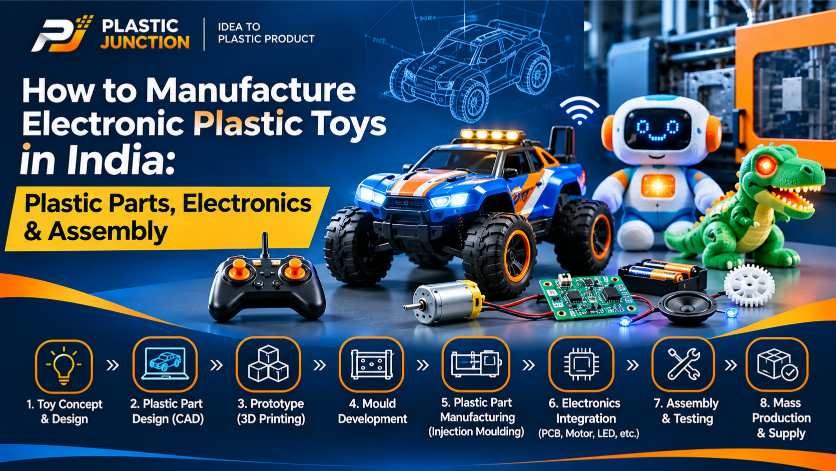
How to Manufacture Electronic Plastic Toys in India: Design, Components & Assembly
From motorized cars to interactive robots, discover how plastic product design, mould development, electronics integration, and assembly come together to create electronic toys.
But how are electronic plastic toys developed and manufactured in India? Let's explore the key steps involved.
1. Design the Toy and Its Plastic Components
The first step is to develop the toy concept and create a product design using CAD software. The design must accommodate the outer body, internal structure, electronic components, wiring, and assembly requirements.
Suitable plastic materials should be selected based on the toy's intended use, durability, appearance, and safety requirements.
Plan the plastic enclosure and electronics together. This helps ensure correct component placement, secure mounting, and efficient assembly.
2. Develop Prototypes and Moulds
A 3D-printed prototype helps evaluate the toy's shape, dimensions, component placement, and assembly before investing in production tooling.
Once the design is validated, moulds can be developed for manufacturing plastic parts, often using injection moulding for suitable production applications.
3. Integrate Electronic Components
Depending on the toy's functionality, electronic components may include:
- LEDs and lighting modules
- Motors and gear mechanisms
- Speakers and sound modules
- Batteries, switches, and buttons
- Sensors and remote-control receivers
- Printed circuit boards (PCBs)
The plastic design must accommodate these components securely, with suitable provisions for wiring, mounting, and maintenance where required.
4. Assembly and Quality Testing
After plastic parts and electronic components are manufactured or sourced, they are assembled into the finished toy.
Testing should cover functionality, mechanical durability, electrical safety, and age-appropriate hazards. Applicable Indian toy safety standards and certification requirements must be evaluated before commercial sale.
Requirements can vary by toy category and design. Confirm applicable BIS standards and certification obligations before manufacturing for commercial sale.
5. Plan for Mass Production
Before scaling production, businesses should evaluate tooling investment, component availability, assembly costs, production capacity, and expected demand.
Depending on the product and business model, plastic manufacturing, electronics sourcing, and final assembly may be handled by different specialist partners.
How Can Plastic Junction Help?
Plastic Junction supports businesses exploring plastic product development and manufacturing through:
Custom Product Design
Product design and reverse engineering to help translate concepts into manufacturable designs.
Rapid Prototyping
3D printing to review form, fit, component placement, and assembly before tooling.
Mould & Tool Room Assistance
Support with mould design and connections to suitable tooling resources.
Plastic Manufacturing
Explore manufacturing options and bulk production for suitable plastic parts.
For electronic toys, additional specialist partners may be required for electronics design, component sourcing, integration, and testing.
Conclusion
Manufacturing electronic plastic toys involves more than producing a plastic shell. Successful development requires coordinated product design, mould development, electronic integration, assembly, and quality testing.
If you're planning to develop a new toy or explore domestic manufacturing opportunities, contact Plastic Junction to discuss your product development and manufacturing requirements.
Have a Plastic Product Idea? Let's Explore It.
Connect with Plastic Junction to discuss product design, prototyping, mould development, and plastic manufacturing options for your next project.
Contact Plastic Junction
Share Your Thoughts
Have a question, suggestion, or experience to share? Leave a comment and join the conversation with the Plastic Junction community.