
Plastic Junction · Export Guide
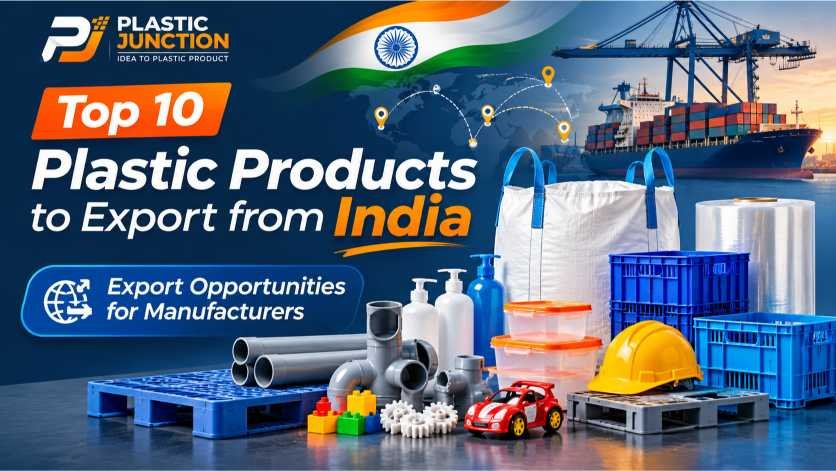
Top 10 Plastic Products to Export from India: Opportunities for Manufacturers
Explore plastic product categories with export potential, likely buyer types, target markets and practical considerations for Indian manufacturers.
India has an established plastics manufacturing and export base, supplying products to markets around the world. According to the Plastics Export Promotion Council (PLEXCONCIL), India’s plastics exports reached approximately US$12.5 billion in FY 2024–25, an increase of around 8% over the previous financial year. Plastic films and sheets, as well as FIBC bags and woven sacks, were among the categories contributing to this performance. Read PLEXCONCIL’s export analysis.
For manufacturers considering exports, the opportunity is not limited to finished consumer products. Industrial packaging, precision-moulded components, films, fittings and specialised products can also serve overseas buyers. The right category depends on your machinery, product quality, certifications, production capacity and ability to compete on landed cost.
1. FIBC Jumbo Bags and Woven Sacks
Flexible intermediate bulk containers (FIBCs), commonly called jumbo bags, and woven polypropylene sacks are used to pack and transport materials such as agricultural products, minerals, chemicals and construction materials.
- Potential buyers: Bulk-material suppliers, agricultural exporters, chemical companies and industrial packaging distributors.
- Markets to research: United States, Europe, the United Kingdom and regional markets in the Middle East.
- What buyers assess: Safe working load, safety factor, fabric strength, stitching, UV resistance, liner options and consistency between batches.
- Key consideration: Food-contact or dangerous-goods applications may require specific testing, documentation or certification. Confirm the applicable standard for the intended use.
PLEXCONCIL reported exports of approximately US$1.57 billion for the combined panel covering FIBC, woven sacks, woven fabrics and tarpaulin in FY 2024–25. This is a combined category, not a figure for jumbo bags alone. Source: PLEXCONCIL.
2. Plastic Films and Sheets
Plastic films and sheets are used in flexible packaging, lamination, labels, agriculture, construction and industrial applications. Product examples include BOPP films, polyester films and selected technical or agricultural films.
- Potential buyers: Packaging converters, printers, laminators, agricultural suppliers and industrial distributors.
- Markets to research: United States, Europe, the Middle East and other markets where the product specification is competitive.
- What buyers assess: Thickness tolerance, tensile properties, clarity, printability, barrier performance and consistency.
- Key consideration: Film extrusion and specialised film production can require significant capital investment. Food-contact uses may need migration testing and destination-specific documentation.
PLEXCONCIL reported approximately US$2.03 billion in exports for the plastic films and sheets panel in FY 2024–25. View export data.
3. Plastic Packaging, Preforms, Caps and Closures
Plastic packaging includes bottles, jars, containers, caps, closures, preforms and flexible packaging used by food, beverage, personal-care, household and pharmaceutical businesses.
- Potential buyers: Packaging distributors, contract packers, consumer-goods manufacturers and packaging converters.
- Markets to research: Nearby regional markets and overseas markets where freight, packaging regulations and buyer specifications make commercial sense.
- What buyers assess: Fit and sealing performance, material consistency, dimensions, decoration, colour matching and production traceability.
- Key consideration: Empty bottles and containers can be expensive to ship because they occupy space. Preforms, caps, closures or nestable designs may improve freight economics, depending on the product and customer.
Requirements differ by product and market. Do not assume that one food-contact approval or material declaration applies everywhere; confirm the destination’s applicable rules before quoting.
4. Custom Injection-Moulded Components
Custom plastic components are used in automotive systems, electrical products, appliances, machinery and consumer goods. Examples include housings, clips, brackets, knobs, connectors and engineered parts made to a buyer’s drawing or specification.
- Potential buyers: OEMs, Tier 1 and Tier 2 suppliers, appliance manufacturers, electronics businesses and industrial product companies.
- Markets to research: Markets where your technical capability, quality system and delivery performance meet supplier requirements.
- What buyers assess: Dimensional accuracy, material selection, tooling quality, repeatability, defect rates, traceability and production capacity.
- Key consideration: Tooling and supplier approval can take time. Automotive, medical and other regulated applications may require sector-specific quality systems or approvals.
HS code 3926 covers a broad range of other plastic articles. It should not be treated as a precise export-value measure for injection-moulded engineering components alone.
5. Plastic Pipes, Tubes and Fittings
PVC, CPVC, HDPE and other plastic pipes and fittings serve plumbing, irrigation, water management, construction and industrial systems.
- Potential buyers: Plumbing distributors, irrigation suppliers, contractors, infrastructure companies and building-material wholesalers.
- Markets to research: Nearby countries and regions with compatible standards, distribution networks and demand.
- What buyers assess: Pressure ratings, dimensions, material grade, joint performance, durability and compliance with the required product standard.
- Key consideration: Pipes can be bulky to transport. Fittings and compact components may be easier to ship, but the economics depend on product value, packing density and freight rates.
Standards vary by country and application. Confirm the buyer’s required ASTM, EN, BS, NSF or other specification where applicable before manufacturing for export.
6. Plastic Household and Kitchen Products
Storage boxes, organisers, buckets, kitchenware, tableware and bathroom accessories can suit exporters with strong moulding, finishing and packaging capabilities.
- Potential buyers: Importers, wholesalers, retail chains, private-label brands and home-product distributors.
- Markets to research: Regional markets and selected markets in North America, Europe and other regions based on buyer requirements.
- What buyers assess: Design, finish, colour consistency, durability, packaging, price and the ability to supply repeat orders.
- Key consideration: Competition can be price-sensitive. Distinctive designs, efficient packing, reliable quality and a clear product range can help differentiate an offer.
For products intended to contact food, verify the relevant food-contact rules in the destination market. Claims such as microwave-safe or dishwasher-safe should be supported by appropriate testing.
7. Plastic Toys and Educational Products
Plastic toys, building blocks, play sets and components for educational products may offer opportunities for manufacturers able to meet demanding safety and quality requirements.
- Potential buyers: Toy brands, importers, distributors and contract-manufacturing partners.
- Markets to research: United States, United Kingdom, Europe and other markets after checking their toy-safety requirements.
- What buyers assess: Safety, age grading, durability, small-parts risk, material quality, packaging and production consistency.
- Key consideration: Toy exports are subject to strict product-safety rules. Check the applicable requirements, testing and certification obligations before accepting orders.
Government figures reported in 2026 put India’s total toy exports across HSN 9503, 9504 and 9505 at US$384.7 million in FY 2025–26. This figure covers several toy and recreation categories, not plastic toys alone. Source: Press Information Bureau.
8. Medical and Healthcare Plastic Products
Medical and laboratory products can include sample containers, diagnostic consumables, selected device components and other plastic products made for healthcare applications.
- Potential buyers: Medical-device manufacturers, healthcare distributors, laboratories and procurement organisations.
- Markets to research: Markets where your product classification, manufacturing controls and regulatory pathway are understood.
- What buyers assess: Material suitability, cleanliness, dimensional consistency, traceability, packaging integrity and validation records.
- Key consideration: Regulatory requirements vary significantly by product and intended use. Some products need controlled manufacturing environments, validated processes and formal market authorisation.
This category is best approached by manufacturers with relevant technical expertise and a clear understanding of the destination market’s medical-device rules. Do not assume every plastic healthcare item requires the same approval.
9. Plastic Building and Construction Products
Products can include selected plastic profiles, fittings, building components and architectural items used in construction and renovation.
- Potential buyers: Building-material distributors, contractors, fabricators and construction-product importers.
- Markets to research: Nearby export markets and regions where the product meets local construction specifications.
- What buyers assess: Dimensions, weathering performance, strength, finish, installation compatibility and documentation.
- Key consideration: Bulky products can be costly to ship. Check packaging, container utilisation and the applicable fire, structural or building requirements before targeting a market.
10. Reusable Crates, Bins and Plastic Pallets
Reusable crates, industrial bins and plastic pallets support warehousing, agriculture, food distribution, manufacturing and logistics operations.
- Potential buyers: Warehouses, logistics providers, agricultural packhouses, manufacturers and distributors.
- Markets to research: Nearby countries and customers with repeat, bulk requirements where freight costs are manageable.
- What buyers assess: Load capacity, stackability, nesting ratio, impact resistance, dimensions, cleaning requirements and expected service life.
- Key consideration: These products can be bulky to ship. Nestable or stackable designs and repeat-volume orders may improve the economics.
How to Choose the Right Plastic Product for Export
The most suitable product is not necessarily the one with the largest reported export value. Assess the opportunity against your own capabilities before investing in new tooling or production capacity.
- Start with your existing strengths. Review your machines, moulds, materials, quality systems and current product range.
- Validate buyer demand. Speak with importers and distributors, review competitor products and request clear specifications before preparing a quotation.
- Calculate landed cost. Include raw material, conversion, tooling amortisation, packaging, inland transport, freight, insurance, duties and destination-specific costs.
- Confirm the HS code. Classification depends on the exact product and can affect duties, documentation and trade restrictions. Confirm it with a qualified customs or trade professional.
- Check compliance early. Identify product testing, labelling, packaging, chemical, food-contact or safety requirements for the destination country.
- Test with a manageable order. Where possible, validate product quality, logistics and payment terms before scaling production.
How to Find International Buyers for Plastic Products
- Trade fairs and buyer-seller meets: Explore relevant plastics, packaging, construction or industry-specific exhibitions and export-promotion events.
- Export promotion organisations: Review resources and market information from PLEXCONCIL and relevant government trade bodies.
- B2B sourcing platforms: Build a clear product profile with specifications, production capacity, quality documents and realistic minimum order quantities.
- LinkedIn outreach: Identify sourcing managers, procurement teams, importers and distributors whose businesses actually use your product. Personalise outreach and lead with relevant capability rather than generic sales messages.
- Your website and product catalogue: Publish accurate specifications, application photos, available materials, quality processes and a clear enquiry method.
Plastic Export Readiness Checklist
- Confirm the correct HS classification and destination-market requirements.
- Check export registration and documentation requirements, including an Importer Exporter Code (IEC) where applicable.
- Prepare a product catalogue, technical data sheets, drawings and material specifications.
- Document quality checks, traceability and relevant certifications or test reports.
- Prepare quotation terms and calculate the full cost of delivering the product.
- Confirm packaging, palletisation, container loading and shipping dimensions.
- Screen buyers and agree payment terms before production or dispatch.
Export documentation and certification requirements depend on the product, transaction and destination. Confirm current requirements with the relevant Indian authorities, export-promotion council, customs professional and buyer before shipping.
Frequently Asked Questions
Which plastic products can Indian manufacturers consider for export?
Options include FIBC bags and woven sacks, films and sheets, packaging components, injection-moulded parts, pipes and fittings, household products, toys, healthcare plastics, construction products and reusable crates. The right choice depends on demand, compliance, production capability and landed cost.
Which plastic product is the most profitable to export?
There is no single answer for every manufacturer. Profitability depends on product specifications, raw-material costs, tooling, order size, competition, freight, certification and payment terms. Validate the economics for a specific product and buyer before investing.
Do I need an IEC to export plastic products from India?
An Importer Exporter Code (IEC) is generally required for commercial exports from India, subject to applicable exemptions. Check the latest DGFT requirements for your business and transaction.
Where can I verify plastic export data and HS codes?
Use the Government of India’s TradeStat portal for trade data and PLEXCONCIL for plastics export-panel reports. Since a single HS code may include many different products, confirm the precise classification for your item before using a figure in a business decision.
Final Thoughts
India’s plastics export sector offers a range of possibilities for manufacturers, from industrial packaging and films to precision components and consumer products. A strong export plan starts with a product that matches your manufacturing capability, verified buyer demand, clear compliance requirements and realistic shipping economics.
Use the categories in this guide as a starting point, then validate demand and costs for your specific product before committing to new machinery, tooling or export orders.
Connect with the Plastic Industry
Plastic Junction brings together people and businesses across the plastics ecosystem. Explore industry connections, suppliers and business opportunities.
Explore Plastic JunctionSources and Further Reading
- PLEXCONCIL – Plastics export statistics and monthly analyses
- PLEXCONCIL – Analysis of India’s Plastics Export, April 2025
- Government of India – TradeStat export data
- Press Information Bureau – India’s toy export figures (FY 2025–26)
Editorial note: Export figures and regulations can change. Figures cited here refer to the stated reporting period and category; they should not be interpreted as guaranteed market size, profitability or eligibility for export.
Share Your Thoughts
Have a question, suggestion, or experience to share? Leave a comment and join the conversation with the Plastic Junction community.