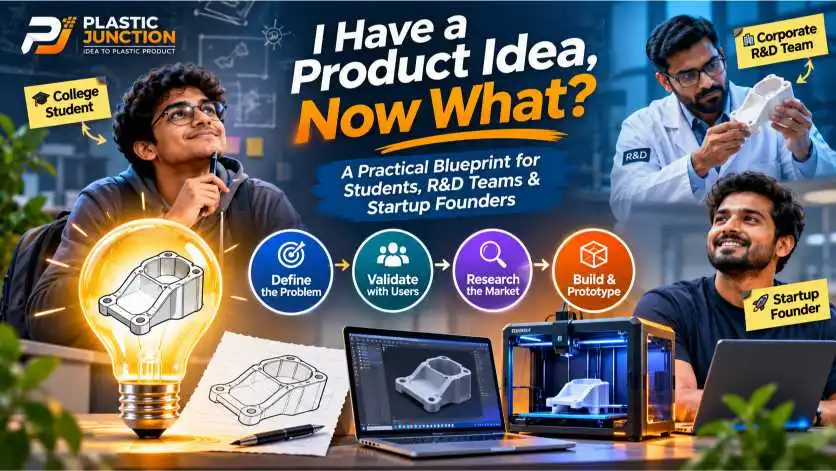
I Have a Product Idea. Now What? A Practical Blueprint from Concept to Creation
A clear first-step guide for students, corporate R&D teams and entrepreneurs who want to turn an idea into something real.
You have an idea. Maybe it came to you during a college project, while solving a problem at work, or while noticing something that could be designed better. The excitement is real—but so is the next question: What should I do first?
The answer is not always “build it immediately.” A better approach is to define the problem, check whether people care, understand the alternatives and then choose a development path that fits your situation.
The Idea-to-Product Roadmap
Step 1: Define the Problem Before the Product
Write the idea down while it is still fresh. Then explain the problem it solves in one sentence. This helps separate the real user need from the features you imagine adding.
For example, instead of “I want to build a smart bottle,” try “People who work outdoors need an easier way to track how much water they drink during the day.” The second statement gives you something concrete to investigate.
Step 2: Validate the Idea with Real People
Before investing heavily in software, machinery or tooling, talk to people who experience the problem. Start with around 10 potential users as an initial learning exercise—not as a statistically conclusive market study.
“When did this problem last happen?” “How do you solve it today?” “What does it cost you in time or money?”
“Would you buy my amazing idea?” often produces polite encouragement rather than useful evidence.
Look for repeated pain points, current workarounds and evidence that people already spend time or money trying to solve the problem. Use what you learn to refine—or even rethink—the idea.
Step 3: Map the Market and Existing Solutions
Search for products, services, patents, open-source projects and workarounds that address the same problem. If alternatives already exist, that can be useful evidence of demand. Your task is to understand what is missing and why someone might choose your approach.
| What to compare | Questions to ask |
|---|---|
| Users | Who is the product designed for? |
| Price and access | Is it affordable and easy to obtain? |
| Performance | What does it do well—and poorly? |
| Opportunity | Can you improve cost, usability, reliability or a specific feature? |
For physical products, also consider material choices, manufacturing methods, assembly, maintenance, safety and end-of-life disposal. If the idea may be patentable, avoid public disclosure until you have taken appropriate advice on intellectual property protection.
Choose the Path That Fits You
The first three steps are broadly similar for everyone. After that, your best next move depends on your environment, resources and goal.
Path 1: The College Student
Goal: Build a proof of concept, learn the process and demonstrate your skills.
- Find complementary teammates: Combine technical, design, research and business skills.
- Use campus resources: Ask professors, labs, innovation cells and incubators about mentorship, equipment and grant opportunities.
- Build a proof of concept: Demonstrate the core idea with the simplest workable model.
- Document the learning: Keep sketches, tests, results and decisions to create a useful portfolio case study.
Path 2: The Corporate R&D Team
Goal: Show how the idea supports business priorities and merits further investment.
- Align with strategy: Identify whether the idea can reduce costs, improve an existing product, create revenue or address a customer need.
- Prepare a concise business case: Explain the problem, evidence, expected value, major costs, risks and next experiment.
- Check IP and ownership: Follow company policy and involve legal or IP specialists early where needed.
- Prototype in stages: Use a low-cost model or limited trial to test the key assumption before requesting a larger budget.
Path 3: The Entrepreneur or Startup Founder
Goal: Test whether a focused solution can attract users and become a viable business.
- Define the MVP: Build only the minimum set of features needed to test the main value proposition.
- Test willingness to pay: Use interviews, a landing page, demonstrations, pilot projects or pre-orders where appropriate. Be transparent that a concept is not yet a finished product.
- Set a spending limit: Decide how much time and money you can afford to use for the first experiment.
- Choose funding based on evidence: Consider bootstrapping, grants, loans or investors only after clarifying the next milestone and the risks.
If It Is a Physical Product, Make the Idea Tangible
When your idea involves a physical object, you can learn a great deal before committing to production tooling. Start with a sketch, simple mock-up or CAD model. Then choose a prototype method based on what you need to test.
Explore form, size, layout and user interaction at low cost.
Check dimensions, fit, assembly and design details before fabrication.
Test a specific question such as ergonomics, fit or basic function.
3D printing can be useful for checking shape, fit and some functional details, but a printed prototype may not behave like the final moulded, machined or production-made part. Choose materials and tests based on the intended use. For products involving electricity, pressure, food contact, children or safety-critical functions, seek appropriate technical and compliance advice before real-world use.
A Simple 7-Day Plan to Get Moving
You do not need to solve everything in a week. Use these seven days to turn a vague idea into a clear next experiment.
Common Mistakes to Avoid
- Building too much too soon: Test the most important assumption before adding features.
- Relying only on friends’ praise: Seek feedback from people who experience the problem.
- Ignoring existing solutions: Understand the alternatives before deciding how your idea is different.
- Underestimating production: For physical products, include materials, tooling, assembly, quality checks, packaging and compliance in your plan.
- Overlooking intellectual property: If protection may matter, seek qualified advice before public disclosure or sharing sensitive details.
- Waiting for perfect conditions: Start with a small, safe experiment that answers one useful question.
Final Thoughts: Turn One Idea into One Action
An idea becomes more valuable when you begin testing it against reality. You do not need a complete business plan, a large team or a finished product to take the first step. You need a clear problem, honest feedback and a manageable experiment.
Your next step starts today
Write down the problem your idea solves. Then choose one person to speak to, one alternative to research or one small prototype to test.
Small experiments create evidence. Evidence helps you decide what to build next.
At Plastic Junction, we believe better products begin with clear problems, thoughtful design and practical collaboration. Keep learning, test your assumptions and take the next step toward your concept.
Share Your Thoughts
Have a question, suggestion, or experience to share? Leave a comment and join the conversation with the Plastic Junction community.