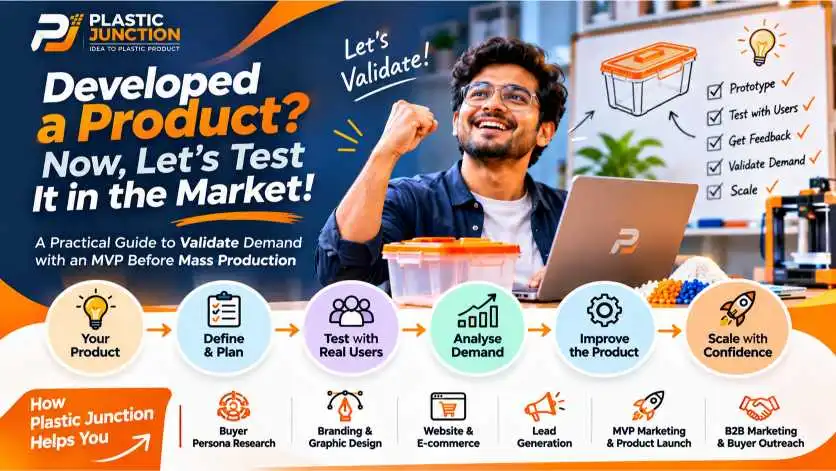
You Built the Product. Now, Will People Buy It?
You’ve put in the thinking, time, money—and probably a few late nights—to bring your product to life. That’s a big deal. But before you order thousands of units or invest in expensive tooling, let’s answer one important question: does the market actually want it?
Here’s a practical, no-fluff guide to testing your product with real potential customers, learning what matters to them, and improving your chances before scaling up.
Build it. Put it in front of the right people. Learn. Improve.
Let’s start with a situation many product teams know well: the product works, the prototype looks promising, and everyone involved is excited. Then comes the big question—“Who is going to buy this, and how do we know?”
What does “validate the market” actually mean?
It means testing your most important assumptions with potential customers before you commit to a big launch. You’re not trying to convince everyone that your product is brilliant. You’re trying to discover what real buyers think—and what they actually do.
Is it solving a real problem?
Does it make a task easier, reduce cost, improve quality, save time, or solve a frustration buyers already have?
Will people pay for it?
Positive comments are nice. A serious enquiry, sample request, paid pilot, or order is stronger evidence of buying intent.
Are you reaching the right people?
The user, buyer, approver, and person who pays may be different people—especially in B2B and manufacturing.
Start with a few assumptions—not a huge production order
Before spending more on stock, tooling, packaging, or advertising, write down what you believe to be true. Keep it simple. You can test these assumptions one by one.
For example, if you’ve developed a new injection-moulded plastic component, your assumptions might be that OEMs need it, the performance is good enough, the price is competitive, and the component can be manufactured consistently. Each assumption deserves a real-world test.
Get specific about your ideal buyer
“Our product is for everyone” sounds exciting, but it makes marketing expensive and unfocused. The more clearly you describe your first likely buyer, the easier it becomes to find them and have a useful conversation.
Ask yourself these questions
- Who experiences the problem most often?
- How do they solve it today?
- Who uses the product—and who approves the purchase?
- What matters most: price, durability, speed, compliance, or convenience?
- How often might they buy, and in what quantity?
Use real interviews to replace assumptions in your persona.
What can your MVP look like?
MVP stands for Minimum Viable Product. In plain English, it’s the simplest version you can put in front of real users to learn whether your key assumptions hold up. It doesn’t have to be a mass-produced product.
Plastic consumer product
Test a small pilot batch, packaging options, usability, durability, and the price customers consider reasonable.
Industrial component
Share a prototype or sample with selected OEMs and ask them to assess fit, performance, specifications, and supply requirements.
Machine or accessory
Arrange a controlled demonstration or pilot installation and record the buyer’s feedback on productivity, safety, and operating cost.
Electronics product
Run a functional prototype trial with a small user group. Test the essential features before investing in extra features.
Packaging solution
Let prospective customers evaluate samples for protection, handling, storage, transport, and compatibility with their process.
Product not ready to ship?
Use a concept page or demo to collect expressions of interest. Clearly state the product’s development status and availability.
Market the MVP without making it complicated
You don’t need to be everywhere on day one. Choose one audience, one clear message, and one action you want a potential buyer to take. Then test that approach before adding more channels.
1. Speak to potential buyers
Ask about the problem, their current solution, decision criteria, and what would make them consider switching. Keep the conversation curious—not salesy.
2. Demonstrate the product
Use clear photos, short videos, a product demo, a sample, or a simple brochure to show what the product does and why it matters.
3. Create a focused landing page
Explain the problem, benefits, key specifications, intended customer, and next step. Try one clear CTA: request a sample, book a demo, or ask for pricing.
4. Run a small, targeted campaign
Reach a defined audience through relevant channels. For B2B products, direct outreach and industry networks may be as important as paid advertising.
Be transparent about whether your product is a concept, prototype, pilot batch, or available for sale. If it isn’t ready to ship, invite people to request information or join a pilot programme—don’t imply that stock is available.
Likes are nice. Buying signals are more useful.
A post can get hundreds of likes and still produce no customers. That doesn’t mean social media is useless; it means you should measure actions that relate to your business goal, not attention alone.
These signals are not guarantees. Interpret them alongside customer feedback, costs, and your sales cycle.
| What to track | What it helps you understand | Example question |
|---|---|---|
| Qualified enquiries | Whether you’re attracting the right audience | Does the lead fit our target customer profile? |
| Sample or demo requests | Whether buyers want to evaluate the product | What do they need to see or test? |
| Paid pilot conversion | Whether interest is turning into commercial action | What is preventing the next step? |
| Objections and rejection reasons | What needs to change in the product or offer | Is the issue price, specs, trust, timing, or fit? |
| Repeat orders and gross margin | Whether the business can work beyond the first sale | Can we deliver consistently and profitably? |
Before you start, decide what success would look like. For example, set a target for qualified conversations, sample evaluations, or paid pilot customers within a defined period. Your target should reflect your product, market, price, and sales cycle—there is no single conversion rate that proves product-market fit for every business.
Use feedback to improve the product—not just the ad
Imagine that people love the idea but hesitate when they see the price. Or they request samples but say the dimensions don’t fit their production line. That feedback is useful. It may point to a pricing, specification, positioning, or customer-fit problem.
“It’s too expensive”
Explore the value they expect, competitor alternatives, cost drivers, and whether a different pack size or offer makes sense.
“It doesn’t fit our needs”
Check dimensions, compatibility, material, performance, certifications, or other must-have requirements.
“We’re not ready yet”
Understand timing, budget cycles, approvals, and the proof they need before making a purchase decision.
Look for patterns rather than changing everything after one conversation. Record what you heard, decide what to test next, and run another small experiment. That is how validation becomes a learning process—not a one-time launch activity.
When is it time to scale production?
There isn’t one magic number of leads or one perfect campaign result. Scaling makes more sense when several pieces of evidence line up—and when your operations can deliver what your marketing promises.
Need help getting your product in front of the right buyers?
You don’t have to figure out every part of product marketing on your own. Plastic Junction can help you build the marketing foundations around your product—from understanding the buyer to creating a credible online presence and generating relevant enquiries.
Buyer persona & audience research
Clarify who you’re targeting, what they care about, and how they make buying decisions.
Branding & graphic design
Develop product-focused creative assets, brochures, catalogues, packaging concepts, and sales materials.
Website & e-commerce development
Showcase your product, communicate value, capture enquiries, or support online transactions.
Lead generation & digital marketing
Use relevant campaigns, SEO, and digital channels to attract and qualify potential buyers.
MVP & product launch marketing
Plan a focused product introduction, test messages, and gather feedback from the right audience.
B2B marketing support
Shape your offer for business buyers and create a clearer path from first contact to a qualified conversation.
Whether you’re preparing a plastic product, industrial component, consumer item, or manufacturing solution, we can help you explore a marketing approach suited to your audience and stage of growth.
Your next 7 days: start learning from the market
| Day | Your task | What you’ll have |
|---|---|---|
| 1 | Write down your top three product assumptions. | A short list of things to test. |
| 2 | Define your first buyer segment and decision-maker. | A focused buyer persona. |
| 3 | Contact relevant potential customers for conversations. | Initial customer insights. |
| 4 | Prepare a demo, sample, prototype, or transparent concept page. | A way to show the product. |
| 5 | Ask for specific feedback and note objections. | A list of buyer needs and concerns. |
| 6 | Test one message and one clear call to action. | Early response data. |
| 7 | Review evidence and choose the next experiment. | A practical next-step decision. |
Use this as a starting point, not a rigid deadline. Complex industrial products may need longer evaluation cycles, technical approvals, and multiple stakeholders.
Have a product ready for the market?
Let’s discuss how buyer research, branding, design, a website, and focused lead generation could help you test your message and reach potential customers.
Explore Plastic JunctionStart with a clear audience. Test one meaningful assumption. Learn before you scale.
Before you go, remember this…
You don’t need every answer before your first market test. You do need a willingness to listen, measure, and improve. Don’t just ask, “Do you like my product?” Ask, “How would you use it? What would stop you from buying it? What would you need to see before choosing it?”
Those conversations can reveal what a polished presentation alone cannot. Build carefully, test honestly, and let real customer evidence guide your next move.
Note: The examples in this article are illustrative. Product validation methods, technical tests, and compliance requirements depend on the product category and intended market. No marketing activity can guarantee product-market fit or commercial success.
Share Your Thoughts
Have a question, suggestion, or experience to share? Leave a comment and join the conversation with the Plastic Junction community.